Who is in the building, and where.
A security company already answers for a client's premises. Indoor tracking adds something a guard at the gate cannot give: a view of the inside.
- Staff and visitors on the plan
- Restricted-zone alerts
- Occupancy per area
- A history to replay
What it gives a control room.
People by floor
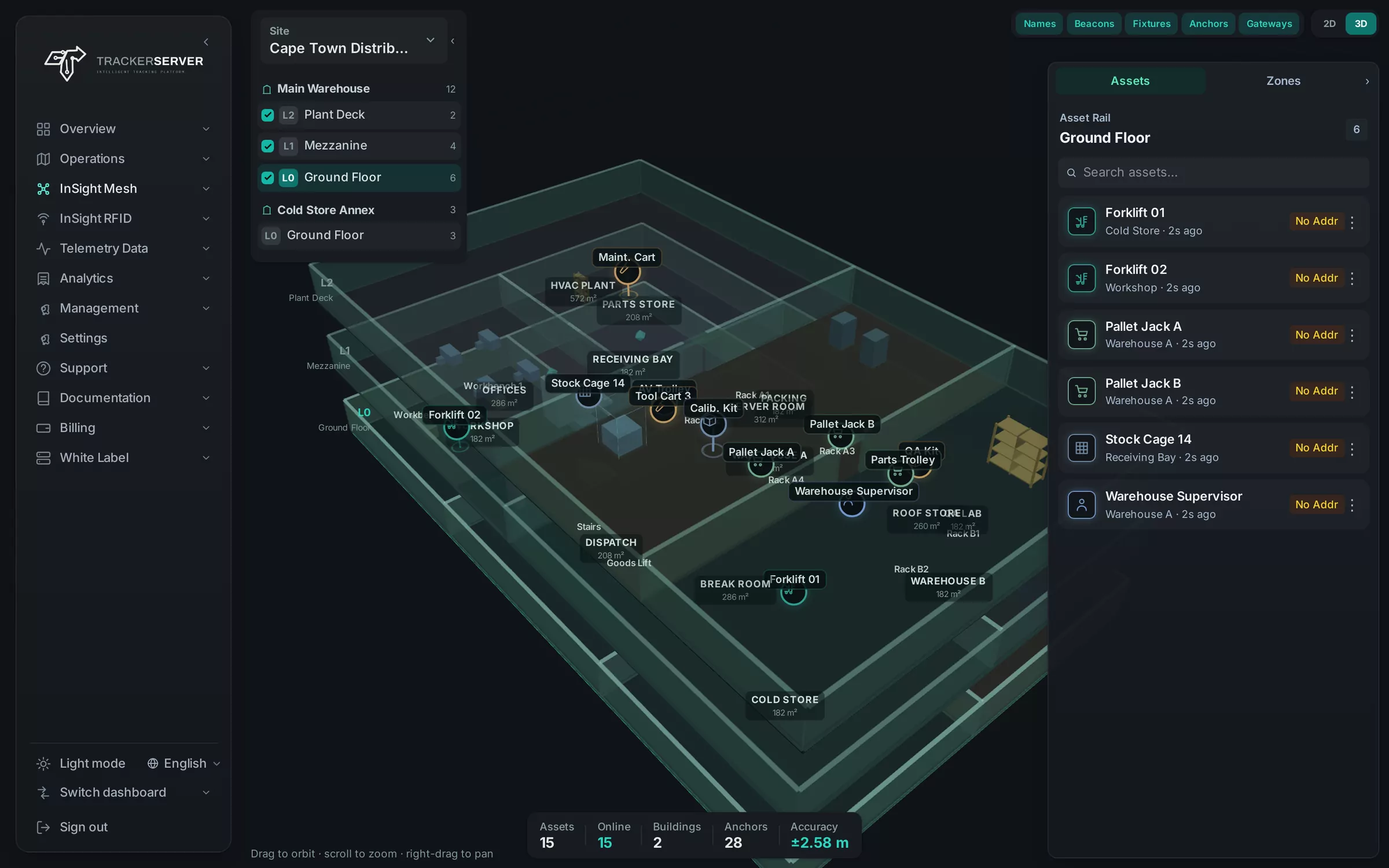
Each person carrying a tag appears on the floor they are on, in the plan or in the 3D building.
Closed areas
Draw a zone, mark it restricted, and a tag entering it raises an alert.
Head counts
How many tags an area holds, and an alert when it passes a limit.
Afterwards
Where a tag went and which zones it passed through, replayed over the plan.
Beside what a security company already runs.
On Trackerserver, indoor tracking sits in the same platform as the tools a security business uses outdoors: vehicle tracking, panic alarms, a responder control room and guard patrol tours with checkpoints.
- Responder control room and app
- Guard patrol with checkpoints
- Panic and SOS alarms
- Vehicle tracking and dashcams
A word on people.
Tracking people is different from tracking pallets, and it should be done openly. A tag is carried, not hidden, and the people who carry one should know what it records and who can see it. In the platform, access to a site is given user by user, so the view of who is where stays with the people who are meant to have it.
Other places
Which of your clients has this problem?
Tell us the kind of site and what goes astray in it. We will set out what a first installation would take, in hardware and on your platform.